Black-Ops Colonel

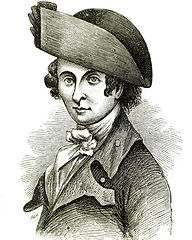
In 1781 Lieutenant Colonel Barrimore St Leger, 34th Foot, played a leading role in what today would be called Black Operations during the American War of Independence.
St Leger was born in County Kildare in 1733. His father, Sir John St Leger, was a judge. If the name is familiar today it’s because his brother, Anthony St Leger, created the St Leger Stakes horse race that has run at Doncaster every September since 1776.
Barrimore or ‘Barry’ to the Army Lists of the time , was educated at Eton College and Cambridge. He joined the Army in April 1756 as an ensign in the 28th Regiment of Foot.
American service
St Leger served in North America under General Jeffery Amherst at the siege of Louisbourg in 1758, and under the command of James Wolfe at the Siege of Quebec in 1759.
He was a staff officer in the campaign by James Murray against Montreal from Quebec in 1760. He became Lieutenant Colonel of the 34th Foot in 1775 and full Colonel in 1780. By 1781 St Leger was commanding forces on the frontier between Lower Canada and New England, under Governor Frederick Haldimand.
It was here that he became involved in Black Ops with the ultimate objective of returning Vermont to the Loyalist side.
Vermont ran alongside the eastern shore of Lake Champlain, but because its boundaries were disputed by New Hampshire and NewYork it had been rejected as an original member of the United States.
Precedent
In the spring of 1781 Captain Azariah Pritchard of the King’s Rangers, kidnapped an American Militia officer, Lieutenant Colonel Thomas Johnson of Vermont.
He had subsequently gone with his family to Quebec and become a secret agent for the British army, carrying out numerous missions in Connecticut and Vermont. On the night of March 8, 1781, Pritchard and ten of his men surprised and abducted Johnson from Peacham, Vermont, and then marched him through the northern woods to the British fort at St. Johns south of Montreal.
Kidnap
Pritchard’s success persuaded Governor Hardimand that significant members of the Rebel side could be kidnapped and that their elimination would help negotiations with Ethan Allen over Vermont abandoning the rebel cause.
Haldimand tasked Captain Justus Sherwood the officer in charge of secret service activities on the northern frontier and and a Loyalist from Vermont, and St Leger with the Operation. An operation that he wanted:
“to be carried into
execution with all possible
dispatch.”
The primary target was retired General Philip Schuyler. Born in Albany, New York State, Schuyler was a member of the prosperous Schuyler family1. He had fought in the Seven Years War alongside the British.
SCHUYLER had planned the Continental Army’s 1775 invasion of Quebec and then the defence of New York in the 1777 Saratoga campaign. He resigned from the Continental Army in 1779.
SHERWOOD and St Leger selected Captain John Meyers to lead the operation. Meyers had abandoned his farm near Albany to join the Loyalists in Canada. He commanded ‘Meyers’s Independent Company’.
For the kidnappings Meyer split his men into eight small groups each with a different target. Each group included two men from the 34th Foot. The Regulars were not in uniform. The plan was for all the groups to be in position to act on the 31 July 1781, but the operation did not run smoothly.
Distracted
One of the groups’ leaders took the opportunity to persuade a woman to elope from Ballstown, which alerted the authorities, then another group were captured at Hoosick Falls with written instructions for the operation. Schuyler was alerted as was Meyer who decided to to wait until the excitement had died down before acting.
Schuyler refused to take any extra precautions. He had a bodyguard of four men from the Second New York Regiment and the family servants.
In the evening of 7 August, Meyer’s group attempted to force open the back door of Schuyler’s home. Schuyler retreated upstairs , whilst his guards and servants fired at the attackers.
Failure
Believing that help was now on its way Meyer retreated, taking away two of Schuyler’s men and some of his silverware. Meyer’s group returned to Canada. None of the groups achieved their objectives.
St Leger retired from the army due to ill health in 1785. He died in Nottinghamshire, on 23 December 1793.
The Editor


Comments